
Truss base plates (square, round, L-shaped/special-shaped, rectangular) show significant differences in core practical dimensions such as load-bearing stability, installation compatibility, space utilization rate, aesthetics, and transportation & storage. Their advantages and disadvantages are fully aligned with the actual needs of stage/exhibition construction, with clear applicable scenario boundaries. Below is a breakdown of the practical pros and cons of each shaped base plate in the order from the most commonly used to niche customized ones, accompanied by applicable scenarios and practical notes, which fit the on-site needs of truss construction:
I. Square Base Plates (Most mainstream, mainly 600×600/750×750/1000×1000mm)
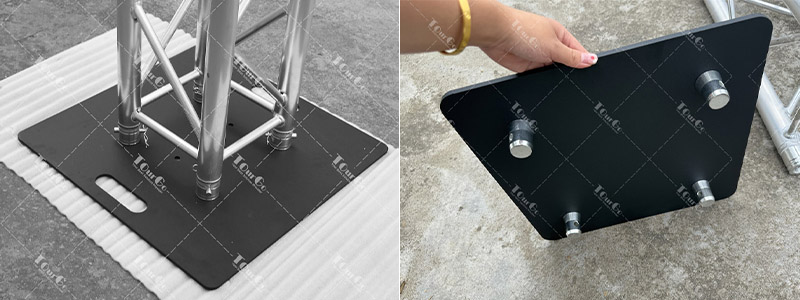
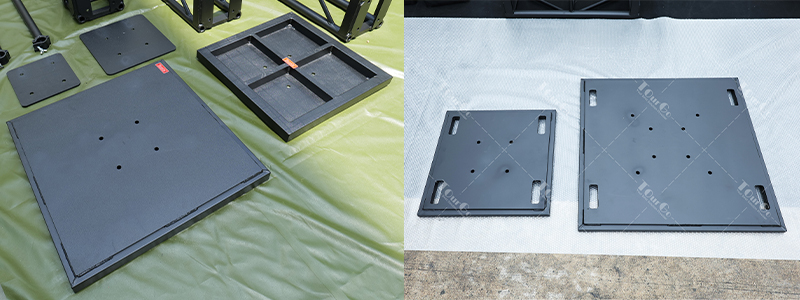
- Optimal load-bearing and force distribution: As a regular regular polygon, the square features symmetrical center of gravity and uniform load transmission to the ground without stress concentration points. With counterweights, it offers the best stability among all shapes, suitable for the core scenario of heavy-duty trusses + lighting and audio hoisting;
- Full compatibility: Multiple sets of holes (horizontal/vertical/diagonal) can be reserved on the plate surface to match trusses of different specifications (square tube/triangular/ladder type). It can also be spliced with multiple plates to expand the load-bearing surface, achieving universal compatibility without threshold;
- Lowest practical cost: Steel/aluminum alloy plates are easy to process and mass-produce at the lowest price; they fit seamlessly when stacked, occupying the smallest space for transportation and storage, thus reducing logistics costs for tour performances and multiple construction projects;
- Easy installation: No directional requirements for ground placement, and construction personnel do not need deliberate alignment, improving on-site construction efficiency.
- Potential issues with edges and corners: Sharp edges and corners are prone to bumping the ground (e.g., hotel marble, exhibition hall epoxy floor) and may scratch construction workers, requiring additional anti-collision pads;
- Average space utilization in narrow areas: In narrow spaces such as wall corners, beside columns, and along passageways, the right angles of squares waste part of the space and cannot fit irregular venues.
Applicable Scenarios
II. Round Base Plates

- More uniform force distribution and higher safety: Without edges and corners, the load is evenly dispersed along the circumference, resulting in lower ground pressure, not easy to damage soft ground (e.g., carpets, wooden floors); in addition, no sharp parts prevent scratches when personnel shuttle, making it more friendly for indoor events;
- Outstanding aesthetics: Smooth lines create a more exquisite visual effect when matched with high-end aluminum alloy trusses, fitting the overall design of high-end events;
- Strong anti-collision performance: Without right angles, it will not damage the base plate itself or surrounding equipment due to collision during stacking in transportation or movement on site.
Core Disadvantages
- Dual low cost and compatibility: Round plates require laser cutting, with a processing cost 30%-50% higher than square ones; the plate surface is limited by the circular outline, with few hole layouts, only matching fixed-specification trusses and unable to be spliced with multiple plates to expand the load-bearing surface;
- Low transportation and storage efficiency: Gaps exist when round plates are stacked, and the loading capacity is 20%-30% less than square ones under the same truck space, leading to higher logistics costs;
- Smaller effective load-bearing surface under the same area: Under the same plate size (e.g., 1000mm diameter vs. 1000×1000mm square), the actual effective load-bearing surface of the round plate is smaller, not suitable for ultra-heavy hoisting.
Applicable Scenarios
III. L-shaped/Special-shaped Base Plates (Including right-angle type, chamfered type, mostly customized)

Core Advantages
- Ultimate space utilization: Perfectly fits irregular venues such as wall corners, beside columns, and trusses attached to walls/columns, making full use of the space in narrow corners and solving the problem of “occupying space and being unable to place” for square/round base plates;
- More fit construction structure: Connecting holes are reserved on the side, which can be directly fixed to walls/columns. No avoidance space needs to be reserved during truss construction, making the overall structure more compact;
- Customized compatibility: The angle (e.g., 80°, 100°) can be adjusted according to the irregularity of the venue to meet the construction needs of non-standard corners.
Core Disadvantages
- Poor load-bearing stability: The asymmetrical shape causes center of gravity offset, prone to tip-over without counterweights. Even with counterweights, the load cannot be transmitted evenly, and it can only be adapted to light-duty trusses (no hoisting/only small lighting hoisting);
- Single compatibility: Customized models only match specific venues and truss layouts, cannot be universally used in other scenarios, and have extremely low later reuse rate;
- High cost and slow processing: As non-standard customization, plate cutting and hole layout require separate mold opening, with long processing cycle and unit price 2-3 times that of square base plates;
- Troublesome transportation and storage: Irregular structures cannot be stacked and fitted, occupying large space, and are prone to collision and deformation due to center of gravity offset during transportation.
Applicable Scenarios
IV. Rectangular Base Plates (Narrow and long type, e.g., 400×1000/500×1200mm, non-standard regular type)


Core Advantages
- Adapted to linear truss construction: Perfectly matches long strip trusses (e.g., stage side strips, exhibition passage trusses, linear trusses for background walls). Placed along the length of the truss, it does not require splicing of multiple square base plates, making the overall structure more concise;
- Friendly to narrow spaces: Narrow width allows placement in narrow areas such as beside passageways and stage edges without occupying main passage/use space;
- Directional hole layout: Holes are reserved on the plate surface along the length direction, no need to adjust the direction when connecting trusses, improving on-site installation efficiency.
Core Disadvantages
- Prone to force offset and poor anti-tip performance: The center of gravity extends along the long axis direction, and it is more prone to tip-over than square ones under lateral force (e.g., wind, personnel collision). Bilateral counterweights must be equipped, and heavy-duty hoisting is not allowed;
- Troublesome stacking and splicing: Rectangular plates need to be strictly aligned with the long axis when stacked, otherwise they are easy to topple; multiple plates can only be spliced along the length direction, not the width direction, resulting in poor flexibility in expanding the load-bearing surface;
- High cost for large-area rectangles: Under the same material, the plate utilization rate of large-area rectangular base plates is lower than that of square ones, with slightly higher processing cost.
Applicable Scenarios
| Shape | Load-bearing Stability | Space Compatibility | Processing/Use Cost | Transportation & Storage Efficiency | Aesthetics | Reuse Rate |
|---|---|---|---|---|---|---|
| Square | ★★★★★ | ★★★★☆ | ★★★★★ (Lowest) | ★★★★★ | ★★★☆☆ | ★★★★★ |
| Round | ★★★★☆ | ★★★☆☆ | ★★☆☆☆ (Higher) | ★★★☆☆ | ★★★★★ | ★★★☆☆ |
| L-shaped/Special-shaped | ★★☆☆☆ | ★★★★★ (Irregular) | ★★☆☆☆ (Highest) | ★★☆☆☆ | ★★★☆☆ | ★☆☆☆☆ |
| Rectangular | ★★★☆☆ | ★★★★☆ (Linear) | ★★★★☆ | ★★★☆☆ | ★★★☆☆ | ★★★☆☆ |
Core Practical Purchasing Suggestions (Fitting Stage/Exhibition Construction Needs)
- Choose square without hesitation for no special requirements: It balances load-bearing, cost and reuse rate, and is the “universal model” for commercial trusses. The edge and corner problem can be solved only by pasting anti-collision pads in high-end indoor venues;
- Choose round for high-end indoor light-duty construction: Prioritize ground protection + aesthetics at the cost of partial load-bearing and cost, suitable for high-requirement events of brand owners/hotels;
- Choose L-shaped only for corner/irregular venues: Only for light-duty support, must be equipped with sufficient counterweights, and try to customize “small sizes” to reduce the risk of tip-over;
- Choose rectangular for linear truss construction: Match the truss length to reduce the number of base plates and keep the site neater. At the same time, add bilateral counterweights to the rectangle to offset lateral force.
- As a professional manufacturer, TOURGO provides reliable and customized truss solutions for global clients.
- Why TOURGO:
- 16+ years experience in truss manufacturing
- One-stop event solution provider
- Custom design & engineering support
- Strict quality control (CE / TÜV / SGS)
- Exported to 100+ countriesMore than just supplying products, TOURGO focuses on safe, durable, and project-based solutions.
-
Build Your Next Event with Confidence
With TOURGO, you get more than products —
You get a reliable partner for your event success
Contact us today to get your customized truss solution!
Post time: Apr-15-2026